Case Summary
A 60-year-old male patient from Mexico was involved in a severe motor vehicle accident, resulting in multiple fractures of the scapula, ribs, and clavicle. The patient presented with chest pain, impaired respiratory movement, and functional instability of the thoracic cage.
Preoperative imaging confirmed displaced rib fractures associated with chest wall instability, along with clavicular involvement. Given the extent of skeletal disruption and the risk of compromised ventilation, surgical stabilization was selected. The procedure was successfully performed by Dr. Israel Eduardo, aiming to restore thoracic alignment, improve respiratory mechanics, and provide stable fixation for early functional recovery.
This case reflects a common challenge in thoracic trauma surgery, where conservative management alone may be insufficient in the presence of displaced rib fractures and structural instability.
Preoperative Imaging Findings
Preoperative radiographic evaluation demonstrated multiple displaced rib fractures with signs consistent with chest wall instability. The disruption of rib continuity indicated abnormal thoracic motion, increasing the risk of respiratory compromise.
Imaging findings played a critical role in confirming the severity of the injury and supported the decision for operative intervention rather than non-surgical management.
Surgical Decision Rationale
Based on imaging-confirmed rib displacement and functional chest wall instability, conservative treatment alone was considered insufficient. Surgical chest wall stabilization was selected to prevent further respiratory deterioration, reduce abnormal thoracic motion, and facilitate early mobilization and pulmonary rehabilitation.
In trauma cases involving multiple rib fractures, timely surgical intervention can significantly improve thoracic mechanics and overall patient recovery when appropriate indications are present.
Surgical Technique Overview
The surgical procedure focused on restoring chest wall stability through internal fixation of the sternum and rib segments, combined with stabilization of associated clavicular fractures when indicated.
Key objectives of the procedure included:
Re-establishing thoracic cage alignment and continuity
Reducing paradoxical chest wall motion
Enhancing respiratory mechanics
Providing stable fixation to support early postoperative mobilization
Low-profile thoracic fixation implants were used to achieve anatomical conformity while maintaining sufficient mechanical strength for trauma applications.
Postoperative Imaging & Outcome
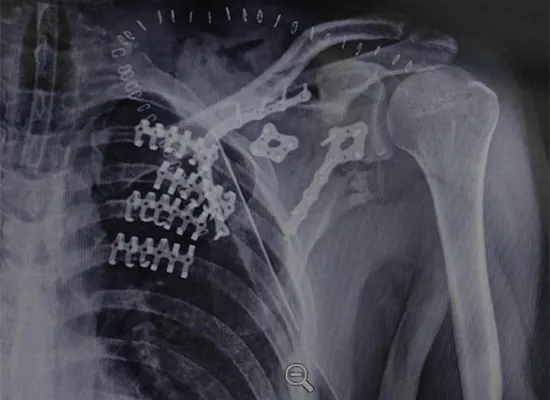
Postoperative imaging confirmed stable fixation of the rib segments and restoration of thoracic alignment. The thoracic cage demonstrated improved structural integrity with no evidence of implant displacement.
The fixation construct provided adequate stability to support postoperative respiratory function and rehabilitation protocols.
Outcome Confirmation
The surgical outcome demonstrated restored anatomical alignment and functional stability of the chest wall, confirming the effectiveness of surgical chest wall stabilization in this trauma case. Imaging verification and clinical improvement indicated a successful intervention.
Implant Specifications Used in This Case
In this procedure, a Chest Wall Stabilization System was utilized to manage displaced rib fractures and restore thoracic stability. The system is specifically designed for thoracic trauma cases involving rib fractures, chest wall instability, and complex skeletal injuries of the chest.
The rib fixation system consists of anatomically contoured rib plates and corresponding locking screws, allowing stable fixation while maintaining a low-profile design. The plates can be contoured intraoperatively to match individual rib anatomy, making them suitable for anterior, lateral, and posterior chest wall fixation. In this case, the system was applied to stabilize displaced rib segments and re-establish the continuity of the thoracic cage.
In addition, a Clavicle Fixation Plate System was applied to address the associated clavicular fracture. Restoring clavicular alignment and length contributed to overall chest wall and shoulder girdle stability, which is particularly important in combined thoracic trauma cases.

Clinical advantages of the implant systems include:
Low-profile plate design to minimize soft tissue irritation
Multiple plate sizes and shapes to accommodate rib and clavicle anatomy
Locking screw technology to enhance fixation stability
Suitability for traumatic rib fractures and chest wall reconstruction
Instrument Set Overview
To support a safe and efficient surgical workflow, a Dedicated Rib Fixation Instrument Set was used during the procedure. This instrument set is specifically developed for rib fracture fixation and chest wall stabilization surgery, covering the full operative process from plate contouring to final screw fixation.
The instrument kit includes plate benders, fracture reduction forceps, drill guides, drilling instruments, and locking screwdrivers, enabling precise handling of rib plates in the limited operative field of thoracic surgery. The organized layout of the instrument tray facilitates smooth intraoperative transitions and helps reduce operative time.
In cases of multiple rib fractures and chest wall instability, the use of a dedicated instrument set improves surgical efficiency and supports accurate implant placement, which is critical for achieving stable fixation and reproducible outcomes.

Key features of the instrument set include:
Complete instrumentation for rib plate contouring, reduction, and fixation
Ergonomic design for controlled handling in thoracic procedures
Modular configuration adaptable to different rib fracture patterns
Suitable for complex thoracic trauma and chest wall stabilization surgery
Surgical Summary & Clinical Takeaways
This Mexico-based trauma case demonstrates that, in selected patients with displaced rib fractures and chest wall instability, surgical stabilization can effectively restore thoracic integrity and improve respiratory mechanics.
Proper patient selection, stable fixation, and postoperative imaging assessment are essential factors in achieving favorable outcomes in thoracic trauma surgery. Chest wall stabilization remains a valuable option for managing complex rib fracture patterns when conservative treatment is insufficient.
FAQ
1. What are the common indications for surgical rib fixation?
Displaced fractures with chest wall instability, impaired ventilation, or high risk of pulmonary complications may be considered.
2. Why is chest wall instability clinically important?
It can reduce ventilation efficiency and worsen respiratory mechanics, increasing complication risk.
3. What role does sternal fixation play in thoracic stabilization?
It helps re-establish anterior thoracic integrity and improves overall cage stability in selected patterns.
4. What is the goal of rib segment fixation?
To restore alignment/continuity, reduce abnormal motion, and improve respiratory mechanics.
5. How is success commonly assessed after rib fixation surgery?
Imaging stability/alignment plus clinical improvements such as breathing comfort and mobilization tolerance.
6. Does rib fixation replace conservative treatment?
No. It’s used for selected patients; many rib fractures are managed conservatively.
7. What are typical benefits of chest wall stabilization in trauma care?
Improved thoracic integrity, better respiratory mechanics, and potentially faster functional recovery.
8. What implant characteristics matter for thoracic fixation?
Low-profile design, adequate strength, anatomical fit, and reliable instrumentation for trauma workflow.