Have any questions?       +86-18112515727       song@orthopedic-china.com
Please Choose Your Language
You are here: Home » News » Intramedullary Nail » Expert Tibial Intramedullary Nail: Complete Guide for Orthopedic Surgeons & Distributors (2026)

Expert Tibial Intramedullary Nail: Complete Guide for Orthopedic Surgeons & Distributors (2026)

Views: 22     Author: Site Editor     Publish Time: 2023-06-14      Origin: Site

facebook sharing button
twitter sharing button
line sharing button
wechat sharing button
linkedin sharing button
pinterest sharing button
sharethis sharing button

Introduction

Tibial fractures are among the most frequently encountered long bone injuries in orthopedic trauma. Because the tibia carries significant mechanical loads while having relatively limited soft tissue coverage, achieving stable fixation without compromising blood supply remains one of the primary objectives of fracture management.

Intramedullary nailing has become the preferred treatment for most displaced tibial shaft fractures due to its minimally invasive nature, excellent biomechanical characteristics, and predictable clinical outcomes. Among the available systems, the Expert Tibial Intramedullary Nail has gained widespread recognition for its advanced locking technology, optimized implant geometry, and versatility across various fracture patterns.

For orthopedic surgeons, the system offers improved surgical flexibility and reliable fixation in both routine and complex trauma cases. For distributors and hospital procurement teams, selecting a high-quality tibial nail system also requires evaluating manufacturing standards, regulatory certifications, instrument compatibility, supply chain reliability, and OEM capabilities.

This guide provides a comprehensive overview of the Expert Tibial Intramedullary Nail, including its indications, structural features, clinical benefits, surgical considerations, and purchasing recommendations for global orthopedic professionals.

What Is an Expert Tibial Intramedullary Nail?


  1. An Expert Tibial Intramedullary Nail is a cannulated internal fixation implant inserted into the medullary canal of the tibia to stabilize fractures while preserving the biological environment required for bone healing. Unlike plate fixation, which often requires extensive soft tissue exposure, intramedullary nailing allows surgeons to achieve stable fixation through a minimally invasive approach.

    The "Expert" design represents an evolution of traditional tibial nail systems by incorporating multiple locking options, improved anatomical alignment, and optimized screw trajectories. These innovations enhance fixation strength, particularly in proximal and distal metaphyseal fractures where conventional nails may offer limited stability.

    Most Expert Tibial Intramedullary Nails are manufactured from titanium alloy or medical-grade stainless steel. Titanium implants are particularly favored because of their excellent biocompatibility, corrosion resistance, and fatigue strength, making them suitable for long-term implantation.

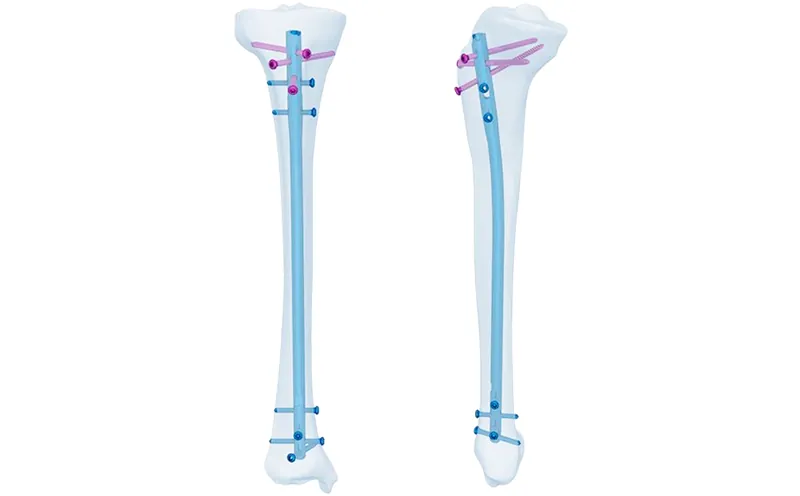
    A complete Expert Tibial Nail system typically consists of:

    - Cannulated tibial nail
    - Proximal locking holes
    - Distal multi-directional locking holes
    - Compression mechanism
    - End cap system
    - Locking screws
    - Dedicated surgical instrument set

    These components work together to provide stable fixation while allowing controlled compression and rotational stability across different fracture configurations.


专家级胫骨钉_副本_副本

Clinical Indications

The Expert Tibial Intramedullary Nail is indicated for a broad spectrum of traumatic tibial injuries. Its versatile locking configuration enables surgeons to treat both simple and complex fracture patterns while maintaining alignment and promoting biological healing.

Tibial Shaft Fractures

Tibial shaft fractures remain the most common indication for intramedullary nailing. Positioned along the mechanical axis of the bone, the implant provides excellent load-sharing characteristics and allows early functional rehabilitation.

Proximal Tibial Fractures

Modern proximal locking configurations improve fixation within the wider metaphyseal region, helping reduce the risk of malalignment while maintaining stable fixation in fractures close to the knee joint.

Distal Tibial Fractures

Multiple distal locking options increase stability in fractures near the ankle, enabling surgeons to manage selected distal fractures without relying solely on plate fixation.

Segmental Tibial Fractures

Long intramedullary fixation bridges multiple fracture sites while preserving overall limb alignment and mechanical stability.

Comminuted Fractures

The implant's load-sharing design and advanced locking technology provide dependable fixation even in highly comminuted fracture patterns where cortical support is limited.

Open Tibial Fractures

Following appropriate debridement and soft tissue management, Expert Tibial Nails may be used in selected open fractures depending on fracture classification and patient condition.

Delayed Union and Nonunion

Exchange nailing with a larger diameter Expert Tibial Nail can provide improved mechanical stability for selected cases of delayed union or aseptic nonunion, supporting fracture healing while minimizing additional soft tissue disruption.

Why Intramedullary Nailing Is Considered the Gold Standard

Over the past two decades, intramedullary nailing has become the preferred fixation technique for most displaced tibial shaft fractures because it combines mechanical stability with biological preservation.

Compared with conventional plate fixation, Expert Tibial Intramedullary Nails offer several clinically important advantages:

  • Smaller surgical incision

  • Reduced soft tissue disruption

  • Better preservation of periosteal blood supply

  • Excellent load-sharing biomechanics

  • Lower risk of implant failure in appropriate indications

  • Earlier postoperative mobilization

  • Reduced hospital stay

  • Faster functional recovery

These advantages have made Expert Tibial Intramedullary Nail systems a standard choice in trauma centers worldwide for the treatment of appropriate tibial fractures.

7_副本

Advantages of Expert Tibial Intramedullary Nailing


  • Enhanced Stability: The expert tibial intramedullary nail provides excellent stability to the fractured tibia, allowing early mobilization and reducing the risk of nonunion.

  • Minimally Invasive: The surgical procedure for implanting the expert nail involves small incisions, resulting in reduced soft tissue damage and faster recovery.

  • Load-Sharing: The nail shares the load-bearing function of the tibia, restoring the bone's natural biomechanics and facilitating efficient healing.

  • Versatility: The expert nail comes in various lengths and diameters, allowing customization according to the patient's anatomy and fracture pattern.


Surgical Procedure and Implantation Technique


The expert tibial intramedullary nail is typically implanted using a minimally invasive approach. After making small incisions, the surgeon inserts the nail into the medullary canal of the tibia, aligning it with the fractured bone fragments. The nail is secured with locking screws at both ends, ensuring stability and fixation.


Rehabilitation and Recovery


Following surgery, a comprehensive rehabilitation program is essential for optimal recovery. Physical therapy plays a crucial role in restoring strength, range of motion, and functionality. The expert tibial intramedullary nail enables early weight-bearing, aiding in the rehabilitation process.

5_副本

Which Tibial Fractures Can Be Treated with an Expert Tibial Intramedullary Nail?

One of the greatest advantages of the Expert Tibial Intramedullary Nail is its versatility. With multiple locking options and improved implant geometry, it can effectively manage a wide range of fracture patterns while maintaining excellent alignment and stability.

Simple Tibial Shaft Fractures

Simple transverse, oblique, and short spiral fractures are the most common indications for intramedullary nailing. The implant provides stable load-sharing fixation that supports early mobilization while preserving the biological environment for fracture healing.

Proximal Tibial Fractures

Fractures near the tibial plateau present unique challenges due to the wider metaphyseal canal and the increased risk of malalignment. The Expert Tibial Nail incorporates multiple proximal locking options that improve fixation strength and help maintain anatomical alignment throughout the healing process.

Distal Tibial Fractures

Distal tibial fractures require precise fixation because of the limited bone stock near the ankle joint. Advanced distal locking configurations provide enhanced rotational stability and improve fixation in fractures that were traditionally managed with plate systems.

Segmental Tibial Fractures

Segmental fractures involve multiple fracture levels along the tibia. A long intramedullary implant bridges the injured segments while maintaining overall limb alignment and allowing biological healing across each fracture site.

Comminuted Fractures

Highly comminuted fractures often lack sufficient cortical support. The Expert Tibial Nail functions as a load-sharing implant, providing reliable stabilization without requiring extensive periosteal stripping or additional soft tissue disruption.

Selected Open Tibial Fractures

After appropriate wound management and debridement, intramedullary fixation is widely accepted for many Gustilo Type I and selected Type II open fractures, depending on the patient's clinical condition and the surgeon's treatment strategy.

Advantages of the Expert Tibial Intramedullary Nail

Compared with traditional fixation methods, the Expert Tibial Intramedullary Nail offers significant biomechanical and clinical advantages that benefit both surgeons and patients.

Minimally Invasive Surgical Technique

The implant is inserted through a relatively small incision, reducing soft tissue trauma and preserving periosteal blood supply. This minimally invasive approach contributes to improved fracture healing and lower postoperative complication rates.

Excellent Mechanical Stability

Positioned within the mechanical axis of the tibia, the nail shares physiological loading with the surrounding bone rather than completely shielding it. This load-sharing principle supports natural bone remodeling and reduces the risk of implant failure.

Enhanced Rotational Stability

Multiple locking screw configurations significantly improve rotational control, especially in proximal and distal fracture patterns where maintaining alignment can be challenging.

Early Weight-Bearing Potential

Depending on fracture type and surgeon assessment, stable intramedullary fixation may allow earlier functional rehabilitation compared with certain alternative fixation methods.

Reduced Risk of Soft Tissue Complications

Unlike conventional plating procedures that require wider surgical exposure, intramedullary nailing minimizes soft tissue disruption and helps preserve local vascularity.

Broad Clinical Applications

The system can be used for traumatic fractures, delayed unions, selected nonunions, and various complex fracture configurations, making it a versatile solution for orthopedic trauma surgery.

Key Design Features

The performance of an Expert Tibial Intramedullary Nail depends not only on surgical technique but also on implant engineering. Modern systems incorporate several advanced design features that improve fixation reliability across different clinical scenarios.

Multiple Proximal Locking Options

Multiple proximal locking holes provide enhanced fixation for metaphyseal fractures while helping maintain alignment in fractures close to the knee joint.

Multi-Directional Distal Locking

Distal locking holes are designed in different orientations to improve rotational control and increase stability near the ankle.

Cannulated Design

The cannulated structure allows implantation over a guide wire, improving surgical accuracy and simplifying the insertion process.

Anatomically Optimized Geometry

Modern Expert Tibial Nails are designed to follow the natural anatomy of the tibial medullary canal, reducing insertion resistance while improving overall implant positioning.

Titanium Alloy Construction

Titanium alloy offers an excellent combination of mechanical strength, corrosion resistance, fatigue performance, and biocompatibility. These characteristics contribute to long-term implant reliability.

Comprehensive Instrument Compatibility

Dedicated surgical instruments, targeting devices, reamers, guide wires, and locking screw systems are specifically engineered to improve procedural efficiency and surgical precision.

Surgical Procedure Overview

Although surgical techniques may vary according to surgeon preference and fracture characteristics, the standard workflow generally includes the following steps:

  1. Patient positioning and fluoroscopic evaluation.

  2. Identification of the appropriate entry point.

  3. Guide wire insertion.

  4. Canal preparation through sequential reaming when indicated.

  5. Selection of appropriate nail diameter and length.

  6. Nail insertion using dedicated instrumentation.

  7. Proximal locking screw placement.

  8. Distal locking screw fixation under fluoroscopic guidance.

  9. Final alignment assessment and wound closure.

Careful preoperative planning, accurate implant selection, and proper locking screw placement are essential for achieving optimal clinical outcomes.

Expert Tibial Nail vs Conventional Tibial Nail

Feature

Expert Tibial Intramedullary Nail

Conventional Tibial Nail

Proximal Locking Options

Multiple multi-planar locking configurations

Limited locking positions

Distal Locking Options

Multi-directional locking

Standard locking

Rotational Stability

Excellent

Good

Stability in Proximal Fractures

Excellent

Moderate

Stability in Distal Fractures

Excellent

Moderate

Anatomical Design

Optimized for modern fracture management

Conventional straight design

Surgical Flexibility

High

Moderate

Complex Fracture Management

Highly suitable

Limited in challenging cases

Instrument System

Comprehensive dedicated system

Basic instrument compatibility

Clinical Applications

Broad spectrum of fracture patterns

Primarily simple shaft fractures

The advanced locking technology and optimized implant geometry make the Expert Tibial Intramedullary Nail particularly suitable for managing complex fracture patterns that require greater mechanical stability and surgical flexibility. These improvements have contributed to its widespread adoption in modern orthopedic trauma practice.

How to Choose a Reliable Expert Tibial Intramedullary Nail Manufacturer

Selecting an Expert Tibial Intramedullary Nail supplier involves much more than comparing product prices. For orthopedic distributors, hospitals, and procurement teams, choosing the right manufacturing partner directly impacts product quality, regulatory compliance, customer satisfaction, and long-term business growth.

When evaluating a manufacturer, consider the following key factors:

Quality Management System

A qualified manufacturer should operate under an internationally recognized quality management system such as ISO 13485 to ensure consistent production standards and traceability.

International Certifications

Verify that the products comply with the regulatory requirements of your target market, such as CE certification or other applicable registrations.

Manufacturing Capability

A reliable supplier should have advanced CNC machining equipment, strict quality control procedures, and stable production capacity to ensure consistent product quality.

Complete Product Portfolio

Working with a manufacturer that offers a comprehensive trauma implant range allows distributors to consolidate purchasing, simplify inventory management, and expand their product offerings.

Dedicated Surgical Instrument Systems

High-quality implant systems should be supported by compatible surgical instruments designed to improve procedural efficiency and simplify intraoperative handling.

OEM & Private Label Services

Many distributors prefer manufacturers capable of providing OEM and private label solutions to strengthen their own brands and improve market competitiveness.

Technical Documentation

Professional manufacturers should provide complete technical documentation, including product catalogs, surgical technique guides, material specifications, regulatory certificates, and registration support.

Why Choose CZMEDITECH as Your Orthopedic Implant Partner?

CZMEDITECH specializes in the research, development, and manufacturing of orthopedic implants and surgical instruments for the global medical device market. With extensive international export experience, the company supports distributors, hospitals, and orthopedic surgeons with reliable products and responsive technical service.

Key advantages include:

  • ISO 13485 quality management system

  • CE-certified orthopedic implant solutions

  • Precision manufacturing using titanium alloy and medical-grade stainless steel

  • Comprehensive trauma implant portfolio

  • Complete surgical instrument systems

  • OEM and private label manufacturing

  • Flexible packaging and branding options

  • Stable production capacity and global supply capability

  • Technical documentation for international product registration

  • Professional sales and after-sales support

Whether you are expanding your orthopedic product line or developing a private-label brand, CZMEDITECH provides flexible manufacturing solutions tailored to your business requirements.

Frequently Asked Questions

What is an Expert Tibial Intramedullary Nail?

It is an advanced intramedullary fixation implant designed to stabilize tibial fractures through minimally invasive surgery while providing excellent biomechanical stability.

Which fractures can be treated with an Expert Tibial Nail?

It is commonly used for tibial shaft fractures, proximal tibial fractures, distal tibial fractures, segmental fractures, selected open fractures, and certain delayed union or nonunion cases.

Why is titanium alloy commonly used?

Titanium alloy offers excellent biocompatibility, corrosion resistance, high fatigue strength, and favorable mechanical properties for long-term implantation.

What are the advantages over conventional tibial nails?

Expert Tibial Nails provide multiple locking configurations, improved rotational stability, greater fixation flexibility, and enhanced performance in complex fracture patterns.

Can patients bear weight after surgery?

Weight-bearing recommendations depend on fracture type, fixation stability, bone quality, and the surgeon's postoperative rehabilitation protocol.

Is intramedullary nailing suitable for minimally invasive surgery?

Yes. The procedure typically requires a relatively small incision and minimizes disruption to surrounding soft tissues and periosteal blood supply.

How is the correct nail length selected?

The surgeon determines implant length based on preoperative planning, radiographic measurements, and intraoperative assessment.

Can the implant be removed after fracture healing?

Implant removal may be considered after complete fracture union when clinically indicated, although many implants remain in place without causing long-term problems.

What should distributors look for when selecting a supplier?

Distributors should evaluate manufacturing quality, certifications, production capacity, regulatory support, OEM capability, technical documentation, and long-term supply reliability.

Does CZMEDITECH provide OEM services?

Yes. CZMEDITECH offers OEM and private label manufacturing solutions for orthopedic distributors worldwide.

Are surgical instrument sets included?

Comprehensive surgical instrument systems are available to support efficient implantation and improve procedural workflow.

How can I request a quotation or product catalog?

You can contact the CZMEDITECH sales team to request detailed product catalogs, technical specifications, OEM information, pricing, and distributor cooperation opportunities.

Conclusion

The Expert Tibial Intramedullary Nail has become one of the most widely adopted fixation systems for modern orthopedic trauma due to its minimally invasive technique, reliable biomechanical stability, and versatility across multiple fracture patterns.

For orthopedic surgeons, it offers dependable fixation and supports efficient fracture management. For distributors and procurement teams, selecting a manufacturer with proven quality systems, international certifications, and OEM capabilities is essential for building a competitive and sustainable orthopedic product portfolio.

As a trusted orthopedic implant manufacturer, CZMEDITECH is committed to providing high-quality trauma implant systems, comprehensive surgical instrument solutions, and flexible OEM services to partners worldwide.

If you are looking for a reliable supplier of Expert Tibial Intramedullary Nails or other orthopedic trauma implants, our team is ready to support your business with professional products, technical expertise, and responsive service.

Contact CZMEDITECH

Interested in learning more about our Expert Tibial Intramedullary Nail System?

Contact our team today to request:

  • Product Catalog

  • Technical Specifications

  • Surgical Technique Guide

  • OEM & Private Label Solutions

  • Distributor Pricing

  • Sample Availability

Our specialists are ready to help you find the right orthopedic implant solution for your market.


Contact us

Consult Your CZMEDITECH Orthopedic Experts

We help you avoid the pitfalls to delivery the quality and value your orthopedic need, on-time and on-budget.
Changzhou Meditech Technology Co., Ltd.

Products

Service

Inquiry Now
© COPYRIGHT 2023 CHANGZHOU MEDITECH TECHNOLOGY CO., LTD. ALL RIGHTS RESERVED.